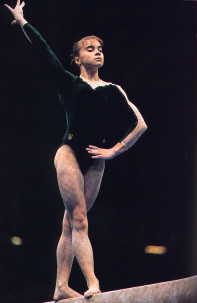
Here is Nastia Liukin reading some awkwardly written prose in a digitally altered voice. I feel I should apologize for my extremely cynical tone, but I have such an instantaneous reaction of dislike towards these things.
This clip suffers with the same chronic dishonesty as many modern day commercials.It is advertising that tries to pretend it is about more than it actually is: the pretence of having any of the truth, feelings and permanence of real art. The reminiscent music, the childlike tone of her voice, the vulnerability of being the lone figure in a lofty gym and those big sad eyes. Even the clothes she wears make a statement - she is simply in comfortable gym shorts and not a competition leotard, which removes the glitz of the performance from the sport and hints at a very non-glamorous ongoing graft.
But the product is so painfully transparent. The words are simply that: WORDS. They convey very little meaning and no passion: like everything they might of meant has been hollowed out in some shiny recording studio. You have to wonder whether Nastia was simply handed these sentences, perhaps on some thick high-quality printer paper by some advertizing exec at NBC, during a three minute window in between visits to Forever 21. "Sound emotional", he may have said.
But the thing that confuses me is that live sport is blind to all of this! Live gymnastics broadcasts cast away the misery of the grind of training and give an exciting, colourful and bright view of the sport. I am not sure that, even if the tone they were clearly trying for had succeeded, it would ever be an incentive to watch the new channel. I can see how some people might feel that it suggests Liukin is poised like a crouched tiger for competition, which would be quite exciting. To me though it just feels like I am supposed to feel sorry for her: as if by watching the channel I would be keeping her company in this lonely, grainy world of perpetual backhandsprings.
This mustn't be mistaken for a big old pop at Nastia - I am right behind her again. After all, why wouldn't she accept the money and the publicity if approached and propositioned? I probably would. This is more a stab at the entire brand of Olympics fluffing. In fairness Nastia is not the only one doing the rounds, Lauren Mitchell has her very own sepia beamy snoozefest too, complete with a gross looking front walk over.
I appreciate this is a large overreaction to what is a fairly inoffensive piece of video, but I find the whole thing I bit emotionally manipulative.
As usual I would love to hear other opinions on this topic.
It is commonly stated that the winner of a world or Olympic level All Around competition is the best gymnast in the world at that time. And on paper this is of course true. An AA champion is the male or female who amasses through their athletic work the greatest total number of points in the competition: they are by all accounts the winner.
But what is it that we expect of an all around champion? Has it changed?
For once, this is not merely about the end of the 10 or the start of uncapped D scores. This is about the common thread of thought amongst gymnastics fans that there was once such a thing as “true all arounders”, and that this iconic definition has, over time, slipped from our screens and scoresheets.
So what does the phrase “true all arounder” actually refer to? To me, it means someone who is not saved by the average. Someone who is great on all events and by virtue of this can truly be crowned the best in the world. To use a similar example, think of final exams. Some people come do well through well rounded success, and others achieve by smashing some papers and simply surviving on others.
It does seem to be true that gymnasts from bygone quads seemed to have a more well rounded talent. Tatiana Gutsu, for example, didn’t appear to have any real noticeable weaknesses. The same could be argued for an early Shannon Miller and Svetlana Boginskaya. Nowadays this is not always the case. People spend a lot of time talking about AAers vs specialists, but in the modern day of the open ended code is there anything except specialists with a few shortfalls? Are modern day gold medallists simply specialists in AA leotards?
One of the gymnasts most memorably referred to as a true all arounder is Ukrainian superstar Lilia Podkopayeva. At even the mention of her name I can hear Elfi Schlegel squeaking on about her being the true package gymnast from the 1996 AA coverage. It is true in a way: Lilia was really quite good on all 4 of the events. But can even she be classed as a true AAer?
My main point here is this: when one thinks hard enough about the true all arounder, the question becomes not whether it has changed, but if it ever existed at all. A “perfect” well rounded competitor would sweep competitions (which in fairness Boginskaya did at the 1990 European Championships). But we rarely ever see this, and in the modern day it is an almost laughable concept. It has become commonplace for gymnasts to make their name on one or two apparatus and put it decent performances on the others to take golds.
In saying this I am not belittling achievements or criticizing podiums: having stand out talent is not a bad thing. But when did it start? I believe that Khorkina was the first gymnast to win major all around titles based mainly on her prowess on a single apparatus. That is not to say that she wasn’t good on the others, but it is to say that without her signature she may not have been top of the world. Let’s check some averages. In the 1997 all around, if we take away the top score before calculating the averages for the top 3 athletes (Khorkina, Amanar, Produnova) the following podium is produced.
Compare this to the 1996 podium: Podkopayeva still wins even without her mammoth floor score to boost her average.
I also calculated this for the 2008 Olympic All Around. I was surprised to find that without Shawn’s beam and Nastia’s bars, they draw. It is interesting to see that they were only separated in the rankings by their specialisms.
To bring this ramble to a close, it is actually surprisingly difficult to think about what we actually look for in an All Around champion. On paper, the thought of a consistent performer who does clean and stable routines across four apparatus is appealing. But in practice this is often really boring (I am thinking people like Sloan and Olaru). But then again, a performer saved by one apparatus with some real low points is unconvincing as a winner.
Things certainly have changed, but I think it is the system and not the gymnasts. Perhaps we would have seen a greater degree of “AA specialism” if the old code was not there as a sort of equalizing upper limit across all four events (it seemed at times that consistency across events was produced by not encouraging the development of difficulty and hence many gymnasts who may otherwise have developed a huge routine somewhere did not have the need to). This works both ways, though: it was probably much easier, once upon a time, to get by despite being “bad” at a particular apparatus. Would Kim Zmeskal and Gina Gogean manage a decent enough bar routine if they were competing in more recent quads?
So, what happened to the All Arounders? Maybe there never were any.
When we consider favourites and least favourites, we generally refer to routines, skills or medals. Perhaps even entire meets. However, is there something about a particular SCORE that could make us like it more than another?
Scores are numbers, and have no meaning except in the context of the routine they grade. Therefore ones liking of a score can never be (and has no reason to ever be) considered separate from the routine it scores. I do however find it interesting that the connotations attached to a score change completely depending on the quad: Kim Zmeskal’s 9.775 on FX in the 1992 AA locked her out of the medals and was considered a disastrously low score, but the same score by Produnova at the 2000 BB EF landed her an individual Olympic medal.
So with this in mind, here are a couple of my favourite (and least favourite) scores.
Favourites
9.862
The significance of this number is twofold. Two different stories, two different Olympics but two fantastic outcomes.
The first is Shannon Miller. Having made it to the Olympics a second time, she was a completely different gymnast to her former self. Having dominated the world for the two years after the Barcelona Olympics (where, in my opinion, she should have taken the all around gold, but more of that below), Shannon had experienced a rocky year prior to the Olympics, looking worn out, too tall for her skills and dogged with injury.
But, she made it to Atlanta and put in a valiant performance to help take the historic team gold. She also managed to qualify second into the AA behind favourite and eventual champ Lilia Podkopayeva. But there were problems. Her vault wasn’t up to scratch and she suffered for the whole Olympics on her floor mount: a double layout that fell out of the air every time she performed it.
The low floor score shut the door on the AA medals for Shannon, a huge disappointment all things considered: her domination of the quad, her qualification, her success in 1992 and the home crowd disappointment (whenever I watch the Atlanta AA it always shocks me how silent and moody the crowd sounds after the third rotation).
But there was salvation: her beam. From qualifications right through to the end she was consistent and stunningly beautiful to watch. Watching the beam final today, it is as though everyone in the arena knows that medal is Shannon’s. There is a certain quiet expectation that does not sound tense, but rather waits without fear for her perfection and the fulfilment of something that is already hers. The final stamping out of that full in dismount and the roaring of the crowd: Shannon Miller wins the 1996 beam final with a 9.862, a hugely well deserved title and a fantastic end to a shining Olympic career.
The second is gymnastics superstar Svetlana Khorkina, a gymnast whose spectacular decade long career was fuelled by disappointment on multiple occasions. The 2000 Olympics were her party, and I know some people don’t like her (and I must respect that), but I think she was fantastic. Never before or since has a gymnast had that much presence, that much attitude and that much fame.
Sveta was already a bars gold medallist. A MULTIPLE gold medallist. She won her first world title on the bars in 1995, and by the time of the Sydney Olympics she had four world titles on the apparatus and 1 Olympic title. So you could hardly say she was the underdog.
However, the ridiculousness of the vault scandal had stripped her of an AA chance. The bars final was her last chance for gold (her last legitimate chance anyway, had Zamo fallen and Sveta taken floor gold people would have been angry and rightfully so). She pulled out what I think to be the performance of her life, and her Ricna-pak-stalder combination is one of my favourites of all time.
9.862: Khorkina repeats as the Olympic champion on bars, a salvaged win from a terrible Olympics.
Two apparatus, two golds, two women, one score.
9.887
I hated Lilia’s floor routine. I thought the music was appalling, the choreography terrible. But I thought the tumbling was incredible. Never before have I seen a better front tumbler, and that first pass, unique to this day, remained among the most impressive feats ever attempted on the floor exercise.
Lilia was one of the few true all around gymnasts, and the huge favourite for the win in Atlanta. Even in such a deep field, she was the only one who could convincingly have worn the gold medal (in my opinion).
Her floor routine, one of the last routines of the competition, was an absolute showstopper. I have already said that I hated most of its aspects, but it didn’t matter. The tumbling and her impeccable form is good enough for me.
Her score of 9.887, the highest of the night, gave her a deadlock on first place.
16.900
In the first departure from the 10 system, we have the score that currently holds the title of the highest score ever recorded in WAG at the world championship/Olympic level. It is of course the score posted for Nastia Liukin’s bar set at the 2008 Olympic WAG team final.
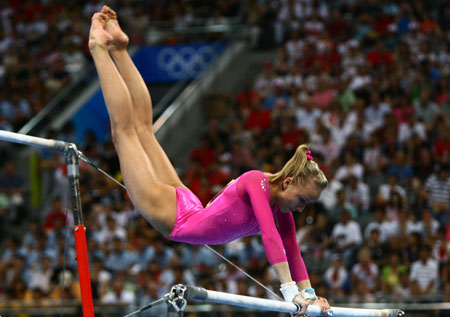
Nastia’s bar set was, and is, breathtaking. By far the most fluently composed and well executed bar set of the quad, Nastia really stamped herself as a legendary uneven bar worker and was hence rightfully rewarded with the highest score of the meet for her TF effort.
Sadly, things didn’t go the same way in the EF, and we all know how that ended. Still, with changes to the code it is feasible that this score may hold its record for a long time to come. Further, with Nastia back in training she may get a second shot at gold.
Least Favourites
9.975
This is an odd one to list as a least favourite, because it is a fantastic score. But I hate it at the same time. Why? Because I think instantly of Shannon Miller on vault at the 1992 Olympics AA.
The vault was one of the most perfect things I have ever seen. It was high, beautifully flighted, a nice tight twist, perfect form and an absolutely planted landing. I really think it should have been a 10.
Shannon was absolutely robbed in this final. It would potentially be more agreeable to say that Gutsu should have scored lower on vault and far lower on floor, but I hate this score because it was one of the best things Shannon ever produced and it didn’t get her the gold.
9.887
The more astute of you may notice that this has appeared on both my favourite and least favourite lists. Here it is with respect to Svetlana Boginskaya’s bars at the 1992 Olympics AA.
Yes, her bars were not as difficult as some. But the code didn’t seem to demand difficultly to the same level it does now. She performed her set the absolute best it could be performed, with not a form error in sight. I understand that those with more difficult routines should be rewarded more, but this score was way too low and prevented her from a medal that she definitely deserved. How did Kim, an appalling bar worker, outscore Bogi here? Scandal.
I like to think of myself as a level headed person, i.e. pretty chilled out about most things. And mostly this is true. Sadly it is a part of the human condition that we all must for some reason be riled by particular people and experiences.
Very few things annoy me as much as the side somersault (for those that are interested, the other few things include excessive hugging, the smell of Britney Spears Fantasy and Tyra Banks’ dress sense). It is just horrible. I remember when I first saw one I thought something had gone horribly wrong. I thought innocently to myself, why would there ever be a coded skill that rewards an ugly takeoff, flight with flexed feet, knees a metre apart and a deep landing? I know more these days, but the question still holds. Why?
Well, as commentators over the years have been keen to point out (such as Christine Still who I believe once said the following: “always a difficult skill to spot”), it is a quite tricky move. I don’t doubt this. It takes a gymnast out of line with the beam and involves what is basically a blind landing: similar issues to a standing Arabian but made easier by less of a twist and the ability for stepout. It is D rated for a reason.
Alexandra Eremia shows us all how its done. Breathtaking.
But what on earth is the point of doing something if it looks so heinous? As is so often forgotten these days, the sport is called “artistic gymnastics”. I would love to know what is artistic about a skill that involves flipping in a position more suitable for giving birth than a beam exercise. In a similar vein to my thoughts on the handspring double front the other day, this is a skill that is by definition ugly, because even textbook execution results in something abysmal looking (a statement which holds at least for the tucked variation).
Essentially, it would make no difference to me if it were rated a G: it still has no place in an otherwise good beam routine. I hate the code for doing things like this because it almost encourages gymnasts and coaches to pay no attention to the flow of the routine in favour of shoehorning another D in there. Difficulty is one thing but something as offensive to the eyes as this skill is another thing entirely. For example, say some girl could do a triple somersault on floor in a LOVELY position like in the following video, would you want it?
I'm alright for now, thanks.
In a brief visit to a less bitter and more fair attitude, however, props to those few who manage to make it look somewhere near presentable. I am thinking mainly of Koko Tsurumi here. But there are not nearly enough like her to outweigh the onslaught of John Waynes just dying to get gun happy. I am looking at you, Nastia. Leave it out next year, yeah?
Nastia Liukin holds up the 2011 qualifications with a special announcement.
So here we are then. In the middle of the qualification days at this year’s much anticipated world championships, Olympic all around champion Nastia Liukin ended years of PR, speculation and will-she-won’t-she forum chat by announcing, finally, that she is training with the aim of the London 2012 Olympics.....
The sentiment is great. I love Nastia Liukin, and I thought that her win in Beijing was more than just a win for her. I thought it was a win for artistry and beautiful gymnastics. A win for the elegance and grace of the sport in the face of a new code that threatened to crown botched amanars, chucked leaps and bent knees as winners. Her gymnastics was as light as a well baked cake. The British commentators bowled over by the precision of her blind landings. All in all, it was the performance of her life (minus the ever disappointing double front half from the bars, but I guess everyone has a chink in their armour somewhere).
So, she took the AA. Good.
But then came the bars final, which was (for me) one of the most disappointing moments in recent gymnastics history. Due to my Beth Tweddle obsession? A little. But mainly because there is no question in my mind that the gold should have been Nastia’s. I accept the issue with tie breaking at the Olympics, and do agree that there should be separation somewhere. I accept the issues of shared D scores. I accept that Nastia’s routine was not perfect. But what i refuse to accept is the idea that a code which places He Kexin’s routine above Nastia’s in is any way, well, acceptable. It just isn’t. (I will take this moment to point out that this is simply one person’s opinion and wish to cause no offence to He kexin fans, nor do I mean to cast a shadow over what is clearly a great amount of talent).
So, Nastia showed up with a stunning routine, performed it near perfectly, and went home with a 1st place silver. Scandalous.
I revisit these memories so as to wonder aloud: is it the bars final Nastia is returning for? A second stab at UB gold? A second chance to face He Kexin and win? Whatever the motivation, I can’t pretend to not be giddily excited to see how it plays out. I just pray that she is a) being truthful, and b)capable of getting back into good enough shape (although it’s clear she has been working out – she hasn’t looked as good as in this video for years).
One thing I do not enjoy, though, is the drawn out nature of the whole thing. The celebrity of it all. Nastia (or as is more likely, her publicity team) have been dangling the prospect of a return in front of fans for a long time, which I think is quite unfair, potentially dishonest, but most of all disrespectful to others forging their own career comebacks. Whilst Nastia constructed Barbie smiles at events and responded to comeback questions with retorts which were essentially “I am not sure yet if I can be bothered”, Alicia, Shawn and Chellsie were sweating it out in the gym making it happen. I didn’t appreciate the tone of these statements: the idea that a second Olympics was there for the taking should she choose to get up and grab it. It made the whole thing sound too easy: as if it was always going to happen.
And this attitude seems to continue. Nastia chose to make this revelation in the midst of the US team’s current struggles. With the loss of Alicia to the dreaded Achilles injury to add to what must have already been a fraught, nervous and inexperienced team, Nastia still stole some of the limelight with her “I’ve been popping into the gym” revelation. Might have been nice to let a few others bask in the limelight for a change. (Then again it is a bit rich of me to complain given that here I am, drafting a response piece. Nastia's PR machine clearly works, despite how Nasty it may seem).
Having said that, though, I am genuinely excited about the prospect of her return (even if it is just as a bars specialist). To see that 1.5 pirouette to Geinger layout a few more times would be brilliant (but a new dismount please). I guess time will tell.