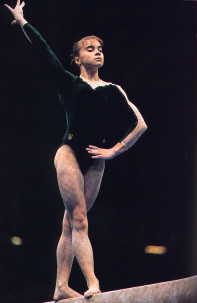
In the past I have elected not to spend much time watching compulsory routines. Why? Because I find watching them incredibly depressing.

This is not, however, due to me disliking them. It is simply due to the fact that I enjoy them to the point where my sadness that they no longer exist begins to outweigh the happiness I get from watching. This may sound like an exaggeration, but I truly believe that compulsory routines were one of the main factors keeping gymnastics artistic, polishing and brilliant throughout the 80s and 90s.
To some, compulsories must have seemed as normal a part of gymnastics as the four apparatus themselves. To others, such as myself, they are a strange and wonderful event which we never had the opportunity to view and discuss in the present tense (at least with any real perspective- I doubt my 7 year old self would have had much to say about the compulsory competition in 1996).

A quick visit to Wikipedia provides the following description of compulsory routines: “[they] heavily emphasized perfect technique, form and execution” - three aspects of the sport that modern gymnastics whiners lament on a daily basis. Sure, there were bad aspects of compulsories; but for a brief few minutes lets indulge in a full scale whinge about one of the sport’s greatest losses.
WHY COMPULSORIES WERE GREAT
They provided (in theory) a standardized, comprehensive test of the basic gymnastic capabilities of every single competitor at a meet - but they were much prettier to look at than an SAT paper. Compulsory exercises, although technically far easier than the optional routines which followed, were just as hard in many aspects because the judges knew EXACTLY what they were looking for. Not once since has the quest for utter perfection been so wonderfully captured: compulsory exercises left no room for slouchy breathers between tumbling passes or half baked corner poses passed off as choreography. Every aspect of the routine was constructed with delivery and technique at the forefront, from the tumbling to the leaps to the simplest of delicate hand movements.
They encouraged real attention to the basics of gymnastics, the bread and butter which act as a solid foundation to all difficulty piled on later. Gluing ones legs together during a back handspring or hitting 180 on a split leap was not a cherry-on-top technicality but an essential pre-requisite to a good score (the attainment or failure of which had profound consequences on ones progression into event finals). Rarely have I seen anywhere else the striking technical perfection right to the tip of the toes that was the norm amongst the top competitors in the compulsory competitions.
Something we have seen less and less of over the years is the stuck landing. My opinions are mixed on this. Obviously nothing ends a routine better, or looks better, that an upright planted landing. However it does get incredibly wearing when commentators begin talking about this 30 seconds before the end and for the entire slow motion replay: it is cool, but not everything. These days, though, with the stuck landing being seen less and less, one can’t help but think that it is losing its place as one of the deciding factors for a medal. At the last Olympics, only 1 of 4 apparatus gold medallists stuck their dismount.
Sandra Izbasa's triple twist: the only "stuck" dismount from the Beijjing event finals
With technique and presentation paramount in the judging of compulsories, stuck landings were a necessity for a huge score (in all fair examples, anyway). Surely having the importance of such endings drummed into ones training regime would make the same mantra spill over into the optional routines? Maybe is compulsories were still around today, training would more greatly reflect the need for a stick.
This point precedes my main reason for loving compulsories: whether consciously or subconsciously, they set an example moving forward into optional routines. If gymnasts have to hit a proper split one day, why not do it the next? Stick a landing one day, why not the next? Polished, expressive choreography one day, why not the next? The list goes on. Basically, compulsories provided an “ideal world” in gymnastics, laying down the standard for technique and artistry.
It seems to me no coincidence that the interpretation of floor music and quality of choreography has declined in general since 1996. Even the floor routines we loved in 2000 had begun to lose some of their artistic edge (which can be seen in the wild differences between Lilia’s golden performance in Atlanta and Zamo’s golden performance in Sydney - but that’s not to say I dislike the latter, I think it is great nonetheless). With compulsory floor routines filled with compulsory choreography, even the least confident and able of dancers would have to learn and practice SOME classic dancing just to get through the stadium doors. Many gymnasts competing today look almost embarrassed by their choreography and unwilling to perform it wholeheartedly.
WHERE COMPULSORIES FELL SHORT
Ironically, although compulsories on paper appear to be the perfect, standardized ideal described above, the reality was often very different. It seems that, with everyone performing the same skills and hence the scoring entirely subjective of the performance, it may have been easier for judges to award the top countries the benefit of the doubt. I believe that the old compulsory system exacerbated the team “score building” phenomenon that was allowed to penetrate the scoreboards for far too long. Such bias acts as a roadblock for emerging gymnastics states, and one cannot help but wonder whether countries like Great Britain and more recently Vietnam (albeit with a single competitor) would have enjoyed the same breakout success had compulsories still been around.
An example from the top of my head comes from the 1992 compulsories, and from one of my all time favourites Svetlana Boginskaya. Svetlana was great, but she benefited from her celebrity. The Wag competitors in the compulsory competition on vault had to work very hard for 9.8+ on the vault, yet Bogi breezes through a 9.850 with a noticeably shaky landing. Would this have been the same if she wasn’t wearing the Unified Team leotard that night? Who knows, but I would venture a no.
Worth a 9.850?
This scored a 9.837...
Lastly, thoughts must turn to the athlete’s stamina. Compulsory competitions mean a whole other rotation of the apparatus. Would today’s girls manage modern difficulty during “optionals” with a whole other day added?
So, admittedly, compulsories were a two sided coin. However, with less international bias these days, and a sorry state of basic presentation and artistry, this gymnastics enthusiast for one would love to see a return of these much missed competitions. I actually think they might nowadays benefit smaller programmes: if added to the team competition and qualifying scores, they would allow basic presentation to factor into the medals as opposed to huge difficulty (in which the powerhouse countries seem to lead the field). They also might play a helping hand in outlawing skill chucking forever, and would definitely help the expressively challenged competitors of the modern day with both a real incentive to improve artistically and a subconscious inclination to do so.
For now, a return seems unlikely. But until such a point, the golden days of compulsory glory should be compulsory viewing for all gymnastics fans.
THREE OF THE BEST (in my humble opinion)
1.The mother of all....
2. Shannon at her best....
3. Sveta keeps it classy....