Showing posts with label Khorkina. Show all posts

Thursday, 2 February 2012

Compulsories: compulsory viewing

In the past I have elected not to spend much time watching compulsory routines. Why? Because I find watching them incredibly depressing.


This is not, however, due to me disliking them. It is simply due to the fact that I enjoy them to the point where my sadness that they no longer exist begins to outweigh the happiness I get from watching. This may sound like an exaggeration, but I truly believe that compulsory routines were one of the main factors keeping gymnastics artistic, polishing and brilliant throughout the 80s and 90s.

To some, compulsories must have seemed as normal a part of gymnastics as the four apparatus themselves. To others, such as myself, they are a strange and wonderful event which we never had the opportunity to view and discuss in the present tense (at least with any real perspective- I doubt my 7 year old self would have had much to say about the compulsory competition in 1996).


A quick visit to Wikipedia provides the following description of compulsory routines: “[they] heavily emphasized perfect technique, form and execution” - three aspects of the sport that modern gymnastics whiners lament on a daily basis. Sure, there were bad aspects of compulsories; but for a brief few minutes lets indulge in a full scale whinge about one of the sport’s greatest losses.

WHY COMPULSORIES WERE GREAT

They provided (in theory) a standardized, comprehensive test of the basic gymnastic capabilities of every single competitor at a meet - but they were much prettier to look at than an SAT paper. Compulsory exercises, although technically far easier than the optional routines which followed, were just as hard in many aspects because the judges knew EXACTLY what they were looking for. Not once since has the quest for utter perfection been so wonderfully captured: compulsory exercises left no room for slouchy breathers between tumbling passes or half baked corner poses passed off as choreography. Every aspect of the routine was constructed with delivery and technique at the forefront, from the tumbling to the leaps to the simplest of delicate hand movements.

They encouraged real attention to the basics of gymnastics, the bread and butter which act as a solid foundation to all difficulty piled on later. Gluing ones legs together during a back handspring or hitting 180 on a split leap was not a cherry-on-top technicality but an essential pre-requisite to a good score (the attainment or failure of which had profound consequences on ones progression into event finals). Rarely have I seen anywhere else the striking technical perfection right to the tip of the toes that was the norm amongst the top competitors in the compulsory competitions.

Something we have seen less and less of over the years is the stuck landing. My opinions are mixed on this. Obviously nothing ends a routine better, or looks better, that an upright planted landing. However it does get incredibly wearing when commentators begin talking about this 30 seconds before the end and for the entire slow motion replay: it is cool, but not everything. These days, though, with the stuck landing being seen less and less, one can’t help but think that it is losing its place as one of the deciding factors for a medal. At the last Olympics, only 1 of 4 apparatus gold medallists stuck their dismount.

Sandra Izbasa's triple twist: the only "stuck" dismount from the Beijjing event finals

With technique and presentation paramount in the judging of compulsories, stuck landings were a necessity for a huge score (in all fair examples, anyway). Surely having the importance of such endings drummed into ones training regime would make the same mantra spill over into the optional routines? Maybe is compulsories were still around today, training would more greatly reflect the need for a stick.

This point precedes my main reason for loving compulsories: whether consciously or subconsciously, they set an example moving forward into optional routines. If gymnasts have to hit a proper split one day, why not do it the next? Stick a landing one day, why not the next? Polished, expressive choreography one day, why not the next? The list goes on. Basically, compulsories provided an “ideal world” in gymnastics, laying down the standard for technique and artistry.

It seems to me no coincidence that the interpretation of floor music and quality of choreography has declined in general since 1996. Even the floor routines we loved in 2000 had begun to lose some of their artistic edge (which can be seen in the wild differences between Lilia’s golden performance in Atlanta and Zamo’s golden performance in Sydney - but that’s not to say I dislike the latter, I think it is great nonetheless). With compulsory floor routines filled with compulsory choreography, even the least confident and able of dancers would have to learn and practice SOME classic dancing just to get through the stadium doors. Many gymnasts competing today look almost embarrassed by their choreography and unwilling to perform it wholeheartedly.

WHERE COMPULSORIES FELL SHORT

Ironically, although compulsories on paper appear to be the perfect, standardized ideal described above, the reality was often very different. It seems that, with everyone performing the same skills and hence the scoring entirely subjective of the performance, it may have been easier for judges to award the top countries the benefit of the doubt. I believe that the old compulsory system exacerbated the team “score building” phenomenon that was allowed to penetrate the scoreboards for far too long. Such bias acts as a roadblock for emerging gymnastics states, and one cannot help but wonder whether countries like Great Britain and more recently Vietnam (albeit with a single competitor) would have enjoyed the same breakout success had compulsories still been around.

An example from the top of my head comes from the 1992 compulsories, and from one of my all time favourites Svetlana Boginskaya. Svetlana was great, but she benefited from her celebrity. The Wag competitors in the compulsory competition on vault had to work very hard for 9.8+ on the vault, yet Bogi breezes through a 9.850 with a noticeably shaky landing. Would this have been the same if she wasn’t wearing the Unified Team leotard that night? Who knows, but I would venture a no.

Worth a 9.850?

This scored a 9.837...

Lastly, thoughts must turn to the athlete’s stamina. Compulsory competitions mean a whole other rotation of the apparatus. Would today’s girls manage modern difficulty during “optionals” with a whole other day added?

So, admittedly, compulsories were a two sided coin. However, with less international bias these days, and a sorry state of basic presentation and artistry, this gymnastics enthusiast for one would love to see a return of these much missed competitions. I actually think they might nowadays benefit smaller programmes: if added to the team competition and qualifying scores, they would allow basic presentation to factor into the medals as opposed to huge difficulty (in which the powerhouse countries seem to lead the field). They also might play a helping hand in outlawing skill chucking forever, and would definitely help the expressively challenged competitors of the modern day with both a real incentive to improve artistically and a subconscious inclination to do so.

For now, a return seems unlikely. But until such a point, the golden days of compulsory glory should be compulsory viewing for all gymnastics fans. 

THREE OF THE BEST (in my humble opinion)

1.The mother of all....


2. Shannon at her best....


3. Sveta keeps it classy....


Wednesday, 9 November 2011

Requiem for the real All Arounders?


It is commonly stated that the winner of a world or Olympic level All Around competition is the best gymnast in the world at that time. And on paper this is of course true. An AA champion is the male or female who amasses through their athletic work the greatest total number of points in the competition: they are by all accounts the winner.

But what is it that we expect of an all around champion? Has it changed?

For once, this is not merely about the end of the 10 or the start of uncapped D scores. This is about the common thread of thought amongst gymnastics fans that there was once such a thing as “true all arounders”, and that this iconic definition has, over time, slipped from our screens and scoresheets.

So what does the phrase “true all arounder” actually refer to? To me, it means someone who is not saved by the average. Someone who is great on all events and by virtue of this can truly be crowned the best in the world. To use a similar example, think of final exams. Some people come do well through well rounded success, and others achieve by smashing some papers and simply surviving on others.

It does seem to be true that gymnasts from bygone quads seemed to have a more well rounded talent. Tatiana Gutsu, for example, didn’t appear to have any real noticeable weaknesses. The same could be argued for an early Shannon Miller and Svetlana Boginskaya. Nowadays this is not always the case. People spend a lot of time talking about AAers vs specialists, but in the modern day of the open ended code is there anything except specialists with a few shortfalls? Are modern day gold medallists simply specialists in AA leotards?

One of the gymnasts most memorably referred to as a true all arounder is Ukrainian superstar Lilia Podkopayeva. At even the mention of her name I can hear Elfi Schlegel squeaking on about her being the true package gymnast from the 1996 AA coverage. It is true in a way: Lilia was really quite good on all 4 of the events. But can even she be classed as a true AAer?


My main point here is this: when one thinks hard enough about the true all arounder, the question becomes not whether it has changed, but if it ever existed at all. A “perfect” well rounded competitor would sweep competitions (which in fairness Boginskaya did at the 1990 European Championships). But we rarely ever see this, and in the modern day it is an almost laughable concept. It has become commonplace for gymnasts to make their name on one or two apparatus and put it decent performances on the others to take golds.

In saying this I am not belittling achievements or criticizing podiums: having stand out talent is not a bad thing. But when did it start? I believe that Khorkina was the first gymnast to win major all around titles based mainly on her prowess on a single apparatus. That is not to say that she wasn’t good on the others, but it is to say that without her signature she may not have been top of the world. Let’s check some averages. In the 1997 all around, if we take away the top score before calculating the averages for the top 3 athletes (Khorkina, Amanar, Produnova) the following podium is produced.


Compare this to the 1996 podium: Podkopayeva still wins even without her mammoth floor score to boost her average. 


I also calculated this for the 2008 Olympic All Around. I was surprised to find that without Shawn’s beam and Nastia’s bars, they draw. It is interesting to see that they were only separated in the rankings by their specialisms.

To bring this ramble to a close, it is actually surprisingly difficult to think about what we actually look for in an All Around champion. On paper, the thought of a consistent performer who does clean and stable routines across four apparatus is appealing. But in practice this is often really boring (I am thinking people like Sloan and Olaru). But then again, a performer saved by one apparatus with some real low points is unconvincing as a winner.

Things certainly have changed, but I think it is the system and not the gymnasts. Perhaps we would have seen a greater degree of “AA specialism” if the old code was not there as a sort of equalizing upper limit across all four events (it seemed at times that consistency across events was produced by not encouraging the development of difficulty and hence many gymnasts who may otherwise have developed a huge routine somewhere did not have the need to). This works both ways, though: it was probably much easier, once upon a time, to get by despite being “bad” at a particular apparatus. Would Kim Zmeskal and Gina Gogean manage a decent enough bar routine if they were competing in more recent quads?

So, what happened to the All Arounders? Maybe there never were any.

Sunday, 6 November 2011

Top Scores

When we consider favourites and least favourites, we generally refer to routines, skills or medals. Perhaps even entire meets. However, is there something about a particular SCORE that could make us like it more than another?

Scores are numbers, and have no meaning except in the context of the routine they grade. Therefore ones liking of a score can never be (and has no reason to ever be) considered separate from the routine it scores. I do however find it interesting that the connotations attached to a score change completely depending on the quad: Kim Zmeskal’s 9.775 on FX in the 1992 AA locked her out of the medals and was considered a disastrously low score, but the same score by Produnova at the 2000 BB EF landed her an individual Olympic medal.

So with this in mind, here are a couple of my favourite (and least favourite) scores.

Favourites


9.862

The significance of this number is twofold. Two different stories, two different Olympics but two fantastic outcomes.

The first is Shannon Miller. Having made it to the Olympics a second time, she was a completely different gymnast to her former self. Having dominated the world for the two years after the Barcelona Olympics (where, in my opinion, she should have taken the all around gold, but more of that below), Shannon had experienced a rocky year prior to the Olympics, looking worn out, too tall for her skills and dogged with injury.


But, she made it to Atlanta and put in a valiant performance to help take the historic team gold. She also managed to qualify second into the AA behind favourite and eventual champ Lilia Podkopayeva. But there were problems. Her vault wasn’t up to scratch and she suffered for the whole Olympics on her floor mount: a double layout that fell out of the air every time she performed it.

The  low floor score shut the door on the AA medals for Shannon, a huge disappointment all things considered: her domination of the quad, her qualification, her success in 1992 and the home crowd disappointment (whenever I watch the Atlanta AA it always shocks me how silent and moody the crowd sounds after the third rotation).

But there was salvation: her beam. From qualifications right through to the end she was consistent and stunningly beautiful to watch. Watching the beam final today, it is as though everyone in the arena knows that medal is Shannon’s. There is a certain quiet expectation that does not sound tense, but rather waits without fear for her perfection and the fulfilment of something that is already hers. The final stamping out of that full in dismount and the roaring of the crowd: Shannon Miller wins the 1996 beam final with a 9.862, a hugely well deserved title and a fantastic end to a shining Olympic career.

The second is gymnastics superstar Svetlana Khorkina, a gymnast whose spectacular decade long career was fuelled by disappointment on multiple occasions. The 2000 Olympics were her party, and I know some people don’t like her (and I must respect that), but I think she was fantastic. Never before or since has a gymnast had that much presence, that much attitude and that much fame.


Sveta was already a bars gold medallist. A MULTIPLE gold medallist. She won her first world title on the bars in 1995, and by the time of the Sydney Olympics she had four world titles on the apparatus and 1 Olympic title. So you could hardly say she was the underdog.

However, the ridiculousness of the vault scandal had stripped her of an AA chance. The bars final was her last chance for gold (her last legitimate chance anyway, had Zamo fallen and Sveta taken floor gold people would have been angry and rightfully so). She pulled out what I think to be the performance of her life, and her Ricna-pak-stalder combination is one of my favourites of all time.

9.862: Khorkina repeats as the Olympic champion on bars, a salvaged win from a terrible Olympics.

Two apparatus, two golds, two women, one score.


9.887

I hated Lilia’s floor routine. I thought the music was appalling, the choreography terrible. But I thought the tumbling was incredible. Never before have I seen a better front tumbler, and that first pass, unique to this day, remained among the most impressive feats ever attempted on the floor exercise.


Lilia was one of the few true all around gymnasts, and the huge favourite for the win in Atlanta. Even in such a deep field, she was the only one who could convincingly have worn the gold medal (in my opinion).

Her floor routine, one of the last routines of the competition, was an absolute showstopper. I have already said that I hated most of its aspects, but it didn’t matter. The tumbling and her impeccable form is good enough for me.

Her score of 9.887, the highest of the night, gave her a deadlock on first place.


16.900

In the first departure from the 10 system, we have the score that currently holds the title of the highest score ever recorded in WAG at the world championship/Olympic level. It is of course the score posted for Nastia Liukin’s bar set at the 2008 Olympic WAG team final.


Nastia’s bar set was, and is, breathtaking. By far the most fluently composed and well executed bar set of the quad, Nastia really stamped herself as a legendary uneven bar worker and was hence rightfully rewarded with the highest score of the meet for her TF effort.

Sadly, things didn’t go the same way in the EF, and we all know how that ended. Still, with changes to the code it is feasible that this score may hold its record for a long time to come. Further, with Nastia back in training she may get a second shot at gold.


Least Favourites

9.975

This is an odd one to list as a least favourite, because it is a fantastic score. But I hate it at the same time. Why? Because I think instantly of Shannon Miller on vault at the 1992 Olympics AA.


The vault was one of the most perfect things I have ever seen. It was high, beautifully flighted, a nice tight twist, perfect form and an absolutely planted landing. I really think it should have been a 10.

Shannon was absolutely robbed in this final. It would potentially be more agreeable to say that Gutsu should have scored lower on vault and far lower on floor, but I hate this score because it was one of the best things Shannon ever produced and it didn’t get her the gold.

9.887

The more astute of you may notice that this has appeared on both my favourite and least favourite lists. Here it is with respect to Svetlana Boginskaya’s bars at the 1992 Olympics AA.


Yes, her bars were not as difficult as some. But the code didn’t seem to demand difficultly to the same level it does now. She performed her set the absolute best it could be performed, with not a form error in sight. I understand that those with more difficult routines should be rewarded more, but this score was way too low and prevented her from a medal that she definitely deserved. How did Kim, an appalling bar worker, outscore Bogi here? Scandal.


0.00


Poor, poor Pavlova. 


Tuesday, 6 September 2011

Waiting for "The Sacramone"


During the next few days, somewhere in Houston, Texas, a piece of gymnastics may be performed that the world of die hard fans waits for with baited breath. I am talking, of course, about what may come to be known as “The Sacramone”, the first eponymous skill of the fantastic vault world champion Alicia Sacramone.
I would be surprised if fans of the sport have yet to hear about this, but if not, check out this training video which surfaced a few weeks ago:

As we can see, “The Sacramone” is a handspring straight 1 and a half somersault with two twists: TWO TWISTS. Thats the same number as a DTY, but flipping forwards and set up only by a handspring entry. You can see why this person chose to put Katy Perry’s firework over the top of this video: to even attempt this vault would require huge levels of explosive power, but luckily that is one of Alicia’s strong points.
But that isn’t all Alicia has to her name. In a time where we see freeze frames of gymnasts blocking on difficult vaults resembling squashed insects, Alicia has impeccable form – pencil straight from head to toe. Matching such explosive power with such control and attention to detail is what makes Alicia such an exciting vaulter to watch. Even in this training video her form is great....imagine what it looks like now (if it is still being trained).
At the moment I feel like a kid on Christmas eve. There is nothing better than watching gymnastics coverage, crisp quality and good commentary, and knowing that the next thing a gymnast will throw is something you have never seen before. It is hugely exciting. Take, for instance, the 2000 Olympic team finals when Khorkina first threw the Khorkina II - what a moment. I am never reserved about my less than favourable opinions on NBC commentary, but in this moment I have some fondness for them and their excitement.


Now let’s just hope, if Alicia does submit this vault, that it gets the huge D score it deserves. Bringing this to worlds would most definitely help Alicia’s cause of repeating as vault world champion: something I would love to see happen as I am sure would fans of difficultly and preciseness the world over. Good luck, Alicia!


Sunday, 4 September 2011

Favourite Routines: Svetlana Khorkina Floor 1996 and 1997

I am a huge fan of Svetlana Khorkina: an admission which is probably received with a groan by other gymnastics fans. Why? Because she is the classic gymnastics pin up, the classic favourite, and people get sick of hearing about it.


But, unlike many Sveta fans, I am not in any denial. She was overscored. Time and time again, particularly in the latter half of her career and particularly (in my humble opinion) on the floor exercise. Time and time again I watch her floor routines from 2000-2004, and each time I wonder how they put the score together. The tumbling, for the most part, is weak. Yes it is often well executed: her twisting was brilliant and her triple was usually exquisite, but her double pike in 2003/2004 was a total knee eater. It is difficult for me to enjoy her tumbling when it looked like her emaciated frame might snap under the pressure of her way-too-deep-landed double somersaults.
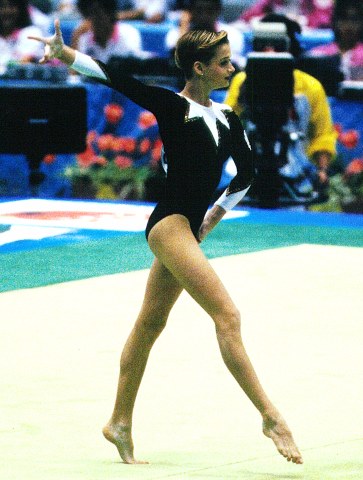
But the one thing I couldn’t understand more than any other was the commentary on her dance. Over and over again, people stated that her tumbling was redeemed by superior grace and choreography. Grace, yes. But choreography? I could only ever see prancing (well timed prancing, but prancing nonetheless) and corner posing. For real choreography from Svetlana, we have to look back in time to her floor routines between 1995 and 1997.
Her Carmen was fantastic. Expressive, original and gripping. I love everything about it: the opening straight into a sprint into that brilliant triple then rebounding into a super original roundoff half twist jump to front walkover, the twisting leap series to shushunova and that ridiculous, show-off ending. It was fantastic.
1997 brought a calmer, more serene exercise. I am not without my thoughts on this one: the music is nice, but something about it makes it sound cheap. Sort of like the kind of thing Shirley Hasting’s might dance to in Strictly Ballroom (for those who don't understand this reference, you are missing out: what a film). But the beauty was still there.
I love Khorkina’s gymnastics, but I lost faith in her floor routines as time went on, and that’s why her 1996/1997 routines remain amongst my favourites.


1996
1997