Showing posts with label 2008. Show all posts

Sunday, 6 November 2011

Top Scores

When we consider favourites and least favourites, we generally refer to routines, skills or medals. Perhaps even entire meets. However, is there something about a particular SCORE that could make us like it more than another?

Scores are numbers, and have no meaning except in the context of the routine they grade. Therefore ones liking of a score can never be (and has no reason to ever be) considered separate from the routine it scores. I do however find it interesting that the connotations attached to a score change completely depending on the quad: Kim Zmeskal’s 9.775 on FX in the 1992 AA locked her out of the medals and was considered a disastrously low score, but the same score by Produnova at the 2000 BB EF landed her an individual Olympic medal.

So with this in mind, here are a couple of my favourite (and least favourite) scores.

Favourites


9.862

The significance of this number is twofold. Two different stories, two different Olympics but two fantastic outcomes.

The first is Shannon Miller. Having made it to the Olympics a second time, she was a completely different gymnast to her former self. Having dominated the world for the two years after the Barcelona Olympics (where, in my opinion, she should have taken the all around gold, but more of that below), Shannon had experienced a rocky year prior to the Olympics, looking worn out, too tall for her skills and dogged with injury.


But, she made it to Atlanta and put in a valiant performance to help take the historic team gold. She also managed to qualify second into the AA behind favourite and eventual champ Lilia Podkopayeva. But there were problems. Her vault wasn’t up to scratch and she suffered for the whole Olympics on her floor mount: a double layout that fell out of the air every time she performed it.

The  low floor score shut the door on the AA medals for Shannon, a huge disappointment all things considered: her domination of the quad, her qualification, her success in 1992 and the home crowd disappointment (whenever I watch the Atlanta AA it always shocks me how silent and moody the crowd sounds after the third rotation).

But there was salvation: her beam. From qualifications right through to the end she was consistent and stunningly beautiful to watch. Watching the beam final today, it is as though everyone in the arena knows that medal is Shannon’s. There is a certain quiet expectation that does not sound tense, but rather waits without fear for her perfection and the fulfilment of something that is already hers. The final stamping out of that full in dismount and the roaring of the crowd: Shannon Miller wins the 1996 beam final with a 9.862, a hugely well deserved title and a fantastic end to a shining Olympic career.

The second is gymnastics superstar Svetlana Khorkina, a gymnast whose spectacular decade long career was fuelled by disappointment on multiple occasions. The 2000 Olympics were her party, and I know some people don’t like her (and I must respect that), but I think she was fantastic. Never before or since has a gymnast had that much presence, that much attitude and that much fame.


Sveta was already a bars gold medallist. A MULTIPLE gold medallist. She won her first world title on the bars in 1995, and by the time of the Sydney Olympics she had four world titles on the apparatus and 1 Olympic title. So you could hardly say she was the underdog.

However, the ridiculousness of the vault scandal had stripped her of an AA chance. The bars final was her last chance for gold (her last legitimate chance anyway, had Zamo fallen and Sveta taken floor gold people would have been angry and rightfully so). She pulled out what I think to be the performance of her life, and her Ricna-pak-stalder combination is one of my favourites of all time.

9.862: Khorkina repeats as the Olympic champion on bars, a salvaged win from a terrible Olympics.

Two apparatus, two golds, two women, one score.


9.887

I hated Lilia’s floor routine. I thought the music was appalling, the choreography terrible. But I thought the tumbling was incredible. Never before have I seen a better front tumbler, and that first pass, unique to this day, remained among the most impressive feats ever attempted on the floor exercise.


Lilia was one of the few true all around gymnasts, and the huge favourite for the win in Atlanta. Even in such a deep field, she was the only one who could convincingly have worn the gold medal (in my opinion).

Her floor routine, one of the last routines of the competition, was an absolute showstopper. I have already said that I hated most of its aspects, but it didn’t matter. The tumbling and her impeccable form is good enough for me.

Her score of 9.887, the highest of the night, gave her a deadlock on first place.


16.900

In the first departure from the 10 system, we have the score that currently holds the title of the highest score ever recorded in WAG at the world championship/Olympic level. It is of course the score posted for Nastia Liukin’s bar set at the 2008 Olympic WAG team final.
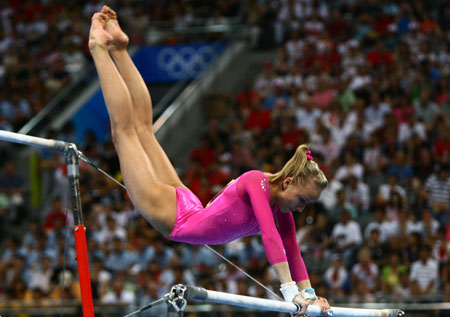

Nastia’s bar set was, and is, breathtaking. By far the most fluently composed and well executed bar set of the quad, Nastia really stamped herself as a legendary uneven bar worker and was hence rightfully rewarded with the highest score of the meet for her TF effort.

Sadly, things didn’t go the same way in the EF, and we all know how that ended. Still, with changes to the code it is feasible that this score may hold its record for a long time to come. Further, with Nastia back in training she may get a second shot at gold.


Least Favourites

9.975

This is an odd one to list as a least favourite, because it is a fantastic score. But I hate it at the same time. Why? Because I think instantly of Shannon Miller on vault at the 1992 Olympics AA.


The vault was one of the most perfect things I have ever seen. It was high, beautifully flighted, a nice tight twist, perfect form and an absolutely planted landing. I really think it should have been a 10.

Shannon was absolutely robbed in this final. It would potentially be more agreeable to say that Gutsu should have scored lower on vault and far lower on floor, but I hate this score because it was one of the best things Shannon ever produced and it didn’t get her the gold.

9.887

The more astute of you may notice that this has appeared on both my favourite and least favourite lists. Here it is with respect to Svetlana Boginskaya’s bars at the 1992 Olympics AA.


Yes, her bars were not as difficult as some. But the code didn’t seem to demand difficultly to the same level it does now. She performed her set the absolute best it could be performed, with not a form error in sight. I understand that those with more difficult routines should be rewarded more, but this score was way too low and prevented her from a medal that she definitely deserved. How did Kim, an appalling bar worker, outscore Bogi here? Scandal.


0.00


Poor, poor Pavlova. 


Sunday, 23 October 2011

No regrets?

Given how nail-bitingly close this years worlds AA final was, I got to thinking about mistakes. Mis-steps. Falls. Form breaks. Chance events that happen in a split second that change the course of a competition and the life of a gymnast forever.

These occurrences are hard to watch, insanely frustrating, but sadly an integral part of the sport. They happen all the time. But some become so notorious that they take on a life of their own.

So I decided to narrow it down to Olympic games from 92 onwards, limit it to 5, include only individual competitions and rank what are, to me, the most heartbreaking WAG mistakes.

1.Svetlana Khorkina – 2000 AA UB
Yes, she divides opinion. And yes, the moments of her first vault in the 2000 AA have been discussed to death. But the incorrect measuring of the vault in Sydney really was one of the biggest embarrassments in sporting history, both in terms of the initial error but also in terms of the handling of the situation (the competition should have been stopped dead and restarted another day).
But the error I consider here is not Khorkina’s vault, it is her bars. Falling from the high bar on her Ricna recatch really was a tragic moment. Such a huge error on her signature apparatus seemed to spell out her feelings of defeat.
Had she held on and scored the same as she did in the event finals, she would still have won the gold even despite the fall on vault. She would have been the deserving winner and perhaps would not have felt the need to carry on until 2004 (sparing us all the uneasy viewing of her emaciated figure and judging bias).


2.Tatiana Lysenko – 1992 AA FX
“She could have won it all, and rightfully so”
This top comment on the youtube video of Tatiana Lysenko’s floor exercise at the 1992 Barcelona Olympics sums it all up for me. Lysenko was the star of these games in my opinion, and if she had gone through cleanly I think she would have deserved the gold. Everything about her gymnastics is amazing, original, and not only cleanly performed but performed in such a way that you can instantly tell that it is her (her hurdles before her roundoff being a brilliant example).
But she didn’t go through cleanly. Although she got good scores on vault (performing a DTY consistently and beautifully - brilliant for her time) and bars, she had problems on beam and this major mistake on the floor. Landing her double layout short and OOB, she took herself out of contention. This is even more of a shame considering the routine she was performing: it was difficult, beautifully choreographed and set to what I consider to be my favourite floor music of all time.
Luckily she redeemed herself in EFs, but her falling out of the AA was a heartbreaking moment.


3.Cheng Fei – 2008 EF FX
The most decorated female gymnast in Chinese history, Cheng Fei, is the kind of athlete you can’t help but love. Why? Because she broke a mould so spectacularly. We are so used to miniscule, delicate and graceful Chinese WAG gymnasts. We see time and time again these girls who can kill a beam set with such beauty, who can pack in a bucket load of pencil straight endo pirouettes; but who can’t do a bar transfer without a muscled kip, can’t tumble and can barely get a DTY around without landing chest to knee. There was always an air of suggestion, that is a Chinese gymnast could be POWERFUL, she would have it all.
Fei didn’t have it all (she couldn’t do bars). But she had pretty much everything else. She was robbed in the floor finals at the 2004 Olympics, but pretty much dominated floor and vault from the start of the code change onwards. They really were hers to lose in Beijjing, and especially after a fall from the beam in the TF, I was really rooting for her to win double gold and be the first since Zamo to do it.
Sadly, she messed up both. I can’t quite decide which was the more heartbreaking of the two, but I would perhaps say floor because at least she rescued a (somewhat undeserving given Sacramone’s E scores) bronze on vault. An underrotated full twisting front layout caused her to sit down and fall straight out of the medals: not her most difficult pass and further, had she compromised her layout form she probably wouldn’t have fallen.
Both were heartbreaking because she was, in my opinion, the deserving gold medallist on both disciplines. Instead she had to settle for two undeserved bronze medals.


4.Elena Zamolodchikova – 2000 AA FX

The 2000 AA was a travesty for reasons we all know. What should rightfully have been a Russian medal sweep became a Romanian medal sweep due to the unfortunate errors of the former. I cannot even bring myself to watch Elena begin her third pass, ironically her easiest, of  her floor routine in the third rotation of the All Around competition. With Khorkina out of the running, it was hers for the taking, but she fell and all was lost.
Similar to the Lysenko story, she redeemed herself valiantly in the EFs becoming a double gold medallist (ironically one of these was the floor exercise – a gold medal in the same discipline that robbed her of a sure win).


5.Beth Tweddle – 2008 EF UB

In 2008 a BRITISH GYMNAST arrived in Beijjing with the hardest uneven bars routine in the world. A decade previously a fan of the sport would have laughed at this statement. Beth changed everything. She has singlehandedly raised the profile of the sport in my country and is very arguably solely responsible for the improvement in the British programme in recent years.
That routine was stunningly good, and it seems unlikely we will see something quite so jam packed again given the changes in the code to include fewer elements (which I agree with incidentally). For the quality of her releases, her progression as a mature gymnast and the reasons listed above, I wanted her so badly to rescue a medal from the bars final. Not the gold (that should have been Nastia’s), but a medal nonetheless.
A medal would have been hers, were it not for a disastrously late toe on full before her dismount. I can’t even imagine her frustration at missing a medal by 0.025 of a point. I am so rooting for a repeat of her TF UB at next year’s finals.


Tuesday, 18 October 2011

Decoded?

The end of the 10 system was treated by many as the end of a golden age. And in many ways, it was. Gymnastics since 2006 has felt somewhat different, and in many ways less exciting. Gone are the days when a step on a dismount loses a medal, when an OOB knocks leaders off the podium and a wobble on beam spells a goodbye to a world title. Excitement on the level of the 1996 AA is lost: there is no longer such a thing as the underdog. In a hypothetical competition where all the competitors hit, the winner is pre decided on the basis of the much slandered open ended D-score.

But is this a bad thing? The debate about open ended scoring is too deep and complex to be considered in any single article. But broad brush statements can still be made. Although the above is true, there are definite benefits to the new system. We see far more exciting skills and a real push towards difficulty and technical ingenuity. The classic gripe of the gymnastics fan is to whether or not this comes at the expense of perfection.

Steliana Nistor being hit by a bus. Oh, wait...

I think pictures such as this represent perfectly the issues with the new code. Here we see Steliana Nistor blocking for a DTY, and resembling a mosquito squashed against a car windscreen. One would argue that the value of difficulty in the new system encourages skill chucking and discourages a fine tuning of skills. This certainly seems true in part for the past few years, but are we seeing a change in the tides?

In recent discussions of possible changes to the code, an idea that caught my attention was that of “D+2E”. Basically, that instead of a final score produced from a combination of difficulty and execution out of 10, the value of the execution score should be doubled before it is added to the difficulty so creating a system that favours the execution side of gymnastics in a throwback to years gone by. This sounds great in practice, but one has to ask the all important question: would it make any difference?

Being a big geek I decided to test this based on the scores from this weekend’s world championships women’s event finals. The following tables represent what would happen were the D+2E rule enforced with these scores.

Vault


Bars


Beam


Floor


I was shocked to find no change whatsoever to the medals. Why? Because in each discipline, the competitor with the highest execution score took the gold medal. This to me suggests that the code might be maturing into something that actually works, favouring both difficulty and execution. It seems that gymnasts and coaches have begun to see renewed value in perfection and are using it to win medals. Yes, the gold medallists also usually had the highest D scores, but the difference now is that they can complete all their skills to an impressive standard. This is, of course, a matter of opinion, but I believe much of the work we saw at this year’s world’s to be of the highest standard of its kind in years (particularly the gold medal winners on every apparatus).

Compare this to the event finals from the 2008 Olympics: with D+2E there would have been a change to every podium except bars.

Vault

YES ALICIA!

Bars


Beam


Floor


I think the times are changing. Execution is coming back.


Results all taken from www.gymnasticsresults.com. Apologies for any potential error in my calculations. Important note: I did not include penalties in the calculations which would certainly have an effect on the outcome but would surely be weighted differently in the d+2e system.

Saturday, 8 October 2011

The (potential) return of Nastia Liukin.

So here we are then. In the middle of the qualification days at this year’s much anticipated world championships, Olympic all around champion Nastia Liukin ended years of PR, speculation and will-she-won’t-she  forum chat by announcing, finally, that she is training with the aim of the London 2012 Olympics.....

Screengrab from above link

The sentiment is great. I love Nastia Liukin, and I thought that her win in Beijing was more than just a win for her. I thought it was a win for artistry and beautiful gymnastics. A win for the elegance and grace of the sport in the face of a new code that threatened to crown botched amanars, chucked leaps and bent knees as winners. Her gymnastics was as light as a well baked cake. The British commentators bowled over by the precision of her blind landings. All in all, it was the performance of her life (minus the ever disappointing double front half from the bars, but I guess everyone has a chink in their armour somewhere).

So, she took the AA. Good.


But then came the bars final, which was (for me) one of the most disappointing moments in recent gymnastics history. Due to my Beth Tweddle obsession? A little. But mainly because there is no question in my mind that the gold should have been Nastia’s. I accept the issue with tie breaking at the Olympics, and do agree that there should be separation somewhere. I accept the issues of shared D scores. I accept that Nastia’s routine was not perfect. But what i refuse to accept is the idea that a code which places He Kexin’s routine above Nastia’s in is any way, well, acceptable. It just isn’t. (I will take this moment to point out that this is simply one person’s opinion and wish to cause no offence to He kexin fans, nor do I mean to cast a shadow over what is clearly a great amount of talent).

So, Nastia showed up with a stunning routine, performed it near perfectly, and went home with a 1st place silver. Scandalous.

I revisit these memories so as to wonder aloud: is it the bars final Nastia is returning for? A second stab at UB gold? A second chance to face He Kexin and win? Whatever the motivation, I can’t pretend to not be giddily excited to see how it plays out. I just pray that she is a) being truthful, and b)capable of getting back into good enough shape (although it’s clear she has been working out – she hasn’t looked as good as in this video for years).

One thing I do not enjoy, though, is the drawn out nature of the whole thing. The celebrity of it all. Nastia (or as is more likely, her publicity team) have been dangling the prospect of a return in front of fans for a long time, which I think is quite unfair, potentially dishonest, but most of all disrespectful to others forging their own career comebacks. Whilst Nastia constructed Barbie smiles at events and responded to comeback questions with retorts which were essentially “I am not sure yet if I can be bothered”, Alicia, Shawn and Chellsie were sweating it out in the gym making it happen. I didn’t appreciate the tone of these statements: the idea that a second Olympics was there for the taking should she choose to get up and grab it. It made the whole thing sound too easy: as if it was always going to happen.

And this attitude seems to continue. Nastia chose to make this revelation in the midst of the US team’s current struggles. With the loss of Alicia to the dreaded Achilles injury to add to what must have already been a fraught, nervous and inexperienced team, Nastia still stole some of the limelight with her “I’ve been popping into the gym” revelation. Might have been nice to let a few others bask in the limelight for a change. (Then again it is a bit rich of me to complain given that here I am, drafting a response piece. Nastia's PR machine clearly works, despite how Nasty it may seem).

Having said that, though, I am genuinely excited about the prospect of her return (even if it is just as a bars specialist). To see that 1.5 pirouette to Geinger layout a few more times would be brilliant (but a new dismount please). I guess time will tell.

Monday, 12 September 2011

Favourite routines - Chellsie Memmel on floor, night 2 of the 2008 Olympic Trials


People always talk about Chellsie Memmel in 2003. They talk about how she was thrown on a world team with very little experience, and how she rose to the challenge fantastically to become one of their highest scoring members. People always seem to remember this Chellsie Memmel. But the Chellsie I like to remember is the Chellsie from the 2008 Olympic Trials.
Who can honestly say they expected what we saw from her? 2007 wasn’t a great year for Chellsie, but she came roaring back in 2008, proving to the world what a strong, gifted gymnast she was. Of all her routines in this competition, my favourite by far is her floor from night 2.


It is exciting from the beginning. I love the way the music crashes in right from the beginning, leading into that powerful sprint into the huge double piked Arabian, which just hangs in the air. And then back again for that double layout – which I always love as a second pass, it must require so much energy!
What I particularly love about this routine, though, is that it proves that there can be fantastic non balletic floor routines. Chellsie isn’t known for her choreography, but this routine was so full of energy and explosive power and interesting artistry achieved in a different way, that it didn’t matter a shred. I am of course referring mainly to the combination beginning with Chellsie’s signature illusion turn...that front handspring to straddle sit with bounce back up to stand is so original and cool – its little details like that which make a routine in my opinion, and really set Chellsie apart from the crowd.
Having said that though, it never hurts to stick a double pike. I don’t think I have seen one landed like that, before or since. Like an arrow into the ground, not even a flicker. And the energy in that room looked amazing...her standing ovation well deserved.
One of the comments on the youtube video is: “This is THE American routine of the decade”. I have to agree. I can’t think of a floor routine by an American woman I have enjoyed more, certainly since 2000 at least. The energy, the power, the music, the non balletic choreography, right down to that great ending pose. I love it all. And thats why Chellsie Memmel on night 2 of the 2008 olympic trials is among my favourite routines of all time. What an unbelievable shame she got injured (but then again given how much she has improved this year we may see a parallel performance at the 2012 olympic trials!)