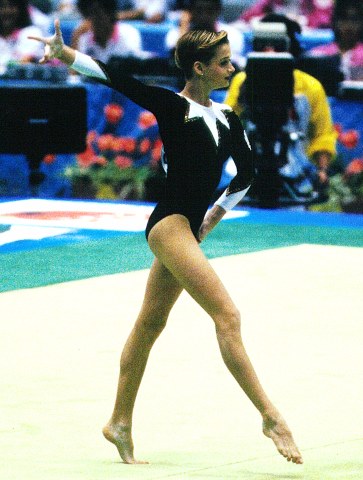
It is commonly stated that the winner of a world or Olympic level All Around competition is the best gymnast in the world at that time. And on paper this is of course true. An AA champion is the male or female who amasses through their athletic work the greatest total number of points in the competition: they are by all accounts the winner.
But what is it that we expect of an all around champion? Has it changed?
For once, this is not merely about the end of the 10 or the start of uncapped D scores. This is about the common thread of thought amongst gymnastics fans that there was once such a thing as “true all arounders”, and that this iconic definition has, over time, slipped from our screens and scoresheets.
So what does the phrase “true all arounder” actually refer to? To me, it means someone who is not saved by the average. Someone who is great on all events and by virtue of this can truly be crowned the best in the world. To use a similar example, think of final exams. Some people come do well through well rounded success, and others achieve by smashing some papers and simply surviving on others.
It does seem to be true that gymnasts from bygone quads seemed to have a more well rounded talent. Tatiana Gutsu, for example, didn’t appear to have any real noticeable weaknesses. The same could be argued for an early Shannon Miller and Svetlana Boginskaya. Nowadays this is not always the case. People spend a lot of time talking about AAers vs specialists, but in the modern day of the open ended code is there anything except specialists with a few shortfalls? Are modern day gold medallists simply specialists in AA leotards?
One of the gymnasts most memorably referred to as a true all arounder is Ukrainian superstar Lilia Podkopayeva. At even the mention of her name I can hear Elfi Schlegel squeaking on about her being the true package gymnast from the 1996 AA coverage. It is true in a way: Lilia was really quite good on all 4 of the events. But can even she be classed as a true AAer?
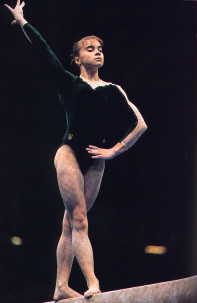
My main point here is this: when one thinks hard enough about the true all arounder, the question becomes not whether it has changed, but if it ever existed at all. A “perfect” well rounded competitor would sweep competitions (which in fairness Boginskaya did at the 1990 European Championships). But we rarely ever see this, and in the modern day it is an almost laughable concept. It has become commonplace for gymnasts to make their name on one or two apparatus and put it decent performances on the others to take golds.
In saying this I am not belittling achievements or criticizing podiums: having stand out talent is not a bad thing. But when did it start? I believe that Khorkina was the first gymnast to win major all around titles based mainly on her prowess on a single apparatus. That is not to say that she wasn’t good on the others, but it is to say that without her signature she may not have been top of the world. Let’s check some averages. In the 1997 all around, if we take away the top score before calculating the averages for the top 3 athletes (Khorkina, Amanar, Produnova) the following podium is produced.

Compare this to the 1996 podium: Podkopayeva still wins even without her mammoth floor score to boost her average.

I also calculated this for the 2008 Olympic All Around. I was surprised to find that without Shawn’s beam and Nastia’s bars, they draw. It is interesting to see that they were only separated in the rankings by their specialisms.
To bring this ramble to a close, it is actually surprisingly difficult to think about what we actually look for in an All Around champion. On paper, the thought of a consistent performer who does clean and stable routines across four apparatus is appealing. But in practice this is often really boring (I am thinking people like Sloan and Olaru). But then again, a performer saved by one apparatus with some real low points is unconvincing as a winner.
Things certainly have changed, but I think it is the system and not the gymnasts. Perhaps we would have seen a greater degree of “AA specialism” if the old code was not there as a sort of equalizing upper limit across all four events (it seemed at times that consistency across events was produced by not encouraging the development of difficulty and hence many gymnasts who may otherwise have developed a huge routine somewhere did not have the need to). This works both ways, though: it was probably much easier, once upon a time, to get by despite being “bad” at a particular apparatus. Would Kim Zmeskal and Gina Gogean manage a decent enough bar routine if they were competing in more recent quads?
So, what happened to the All Arounders? Maybe there never were any.