Showing posts with label Porgras. Show all posts

Tuesday, 17 January 2012

The untimely departure of Ana Porgras

“But I am sure we will see her in the future. Three more years and I am sure she we have more experience”.


And it wasn’t just Christine Still who felt sure. At the 2009 World Championships, many gymnastics fans (included me) believed we were seeing one of the next greats. Ana Porgras is and was a fantastic gymnast, and yesterday’s news of her retirement is incredibly saddening. Saddening for her, saddening for the fans, saddening for Romania and saddening for the entire sport.

Ana was one of the only gymnasts this quad who could truly be called artistic. This simple fact is brilliant enough in its own right, given the times we live in. But further to this: she was a Romanian.
Who do we think of when someone says “Romanian WAG Gymnast”? For me: Simona Amanar, Lavinia Milosovici, Gina Gogean. In other words: compact gymnasts known less for their artistry, and more for their almost robotic consistency, vaulting and tumbling. And of course, their terrible bars.

This was part of what made Ana’s gymnastics so special. She wasn’t just good; she shattered a mould that had been set tight in the Romanian system for decades. Rather than perfunctory choreography, gluey feet and nailed landings, she was all about delicate lines, beautiful presentation and ethereal inconsistency.
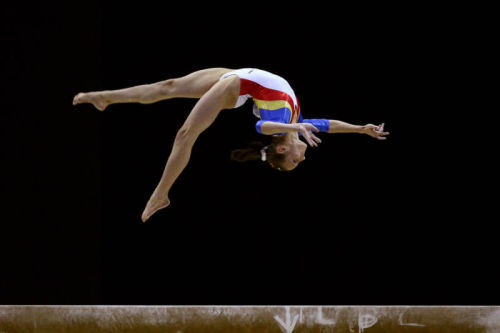


She was the star of the 2009 World Championships, despite winning only one medal. A bronze on the uneven bars - in the final Ana showcased her classic lines and presentation to capitalize on a weak field. This medal is misleading though, as Ana is no bars specialist. It was all about her beam. There was a sense that if she could battle through her inconsistency problems, she would be a beam frontrunner. To me, it seemed like she was poised to upgrade dramatically and would become a real threat in the all around as the quad drew to a close.

2010 saw Ana stay on the beam to win a well deserved world title. However, even by this point, pressures of the code had drained much of the originality, poise and artistry out of her beam routine that had won over the fans and commentators in the first place. Thankfully, she retained her fantastic flight series ending in her super sky high layout. Even here, though, the artistic touches were fading: I loved in 2009 that she began her flight series with a back walk over as opposed to a back handspring. The change in tempo from slow grace to speed and power was fantastic to watch.

The highlight of Ana's career. But.....
...many of the personal touches seen here were gone. Look at that mount, and my favourite BWO into the flight series.

In other respects though, Ana never lived up to the hype that her debut seemed to promise. Unfortunately, she never seemed able to upgrade her vault from a full twisting yurchenko. In an open ended code, a vault start value of 5.0 was never realistically going to cut it against American and Russian 6.5s. Combining this with increasingly scrappy floor routines and bar work that was beginning to plateau around the 14.000 mark, Ana’s chance of impacting an AA podium was seeming slimmer and slimmer each competition.

You could say (as I have suggested in a previous article) that Ana was born into the wrong quad. A delicate, artistic girl with a great FTY would have been right at home in the early nineties. Sadly it is now a game of muscles and mammoth D scores.

A beautiful vault, but sadly lacking in the tariff necessary to compete at the very top level

Regardless of all of the above, and even regardless of making no finals at the 2011 worlds, it still seems a shame to throw in the towel at this point. Easy for the unfatigued spectator to say, but one would think it worth hanging on a few extra months to make all the years of training that bit more worthwhile. Still, all that can be done is to hope that Ana’s decisions are her own, and ones that she does not come to regret later.

And so it is will sadness that Ana Porgras becomes added to a list of fantastic, hugely talented and widely loved athletes who never quite managed to reach their true potential.

Three famous examples of unfulfilled potential


-         MO HUILAN


One gold and two silvers in terms of individual achievement: less than you would imagine for someone who made such a lasting impression on gymnastics. Mo was the epitome of inconsistency which cost her AA medals in 1995 and potentially 1996, and locked her out of the EF of her signature apparatus in Atlanta.

-        DOMINIQUE MOCEANU


Only one individual silver for perhaps the most overhyped American gymnast of all time. Dominique showed exceptional difficulty at a very young age (if age restrictions stay the same she will forever be the youngest American national champion, aged a mere 13 back in 1995). Personal issues and injuries prevented her from coming back strong at the world level beyond the Atlanta Olympics.

-        EKATERINA LOBAZNYUK
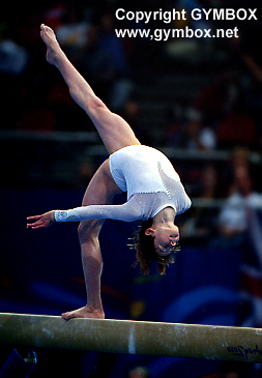


For me the greatest waste of potential of them all. Lobaznyuk was one of the stars of the 2000 Olympic Russian team: in my opinion one of the greatest assemblages of talent in the modern history of the sport. Sadly, they failed to deliver in a spectacular way. Ekaterina’s career was similarly underwhelming in light of the incredible talent that she possessed: she has an individual silver and bronze to her name. A bad vault in 2001 tore her ACL and MCL, which ultimately prevented Lobaz from progressing in the sport. The fact that this girl has neither AA medals nor any floor medals is a real shame. This was surely world class in anyone’s book...

Pictures: http://26.media.tumblr.com/tumblr_lxwdph5pXs1r1zfpao1_500.jpg, http://pics.livejournal.com/ardelive/pic/001a94akhttp://gymnet.org/forum/files/mo_huilan_poutre.jpghttp://www.thecouchgymnast.com/wp-content/uploads/2011/03/moceanu-bb.jpg, http://www.gymbox.net/images/LobaznyukOS001.jpg

Saturday, 24 December 2011

Born This Way

It is Christmas Eve, and time to do what I do best: write an article about what happens to be on my mind and awkwardly shoehorn it into a relevant theme suitable for the times. Let’s have a go then.

This past week I have been thinking about luck of the draw. About the extraneous factors which hugely influence a gymnast’s chance for success on the world stage but are not directly related to their talent and are not things that can be helped. The main thread of this thought is as follows: the code changes each quad. Each new code is bound to favour a certain type of gymnast more than another (in the 05-08 and 09-12 quads, it favoured those who could do an amanar, whereas in 89-92 it favoured those who could stick an FTY, as a simple example). Whilst this gives some gymnasts a right-place-right-time advantage, it also puts some at an instant disadvantage: you could say they were born into the “wrong quad”.

Christmas is a story of a birth. SEAMLESS, right?

Below are the gymnasts that stick out most obviously to me as being born at such a time to put them in a quad which didn’t play to their strengths.

STELLA UMEH


For me, this girl had one of the best flight series on beam of all time. If not THE best. It is one of the most exciting, original and difficult combinations I have ever seen (BHS-LO 2 feet-BHS-LOSO). On a side note, she also had some pretty cool little extras: it was hugely refreshing to see that mount, which I had forgotten about, as I searched for this video. As was the forgotten second acro combination: a cartwheel through to two layout stepouts. Now THESE are beam connections. Fast, flighted and difficult.


So why, then, does this fantastic gymnast not even have her own Wikipedia page? Stella Umeh went on to find success in the NCAA program, where she was the two time floor exercise champion (1995, 1998) for UCLA. Her elite career was no failure: at the 1994 commonwealth games she took the all around title, and followed this with a vault gold and UB silver in events finals. However, on the world stage, recognition of her talent was less forthcoming and Stella has no world level medals to her name.

I do not contest the scores that Stella received: the code at the time valued stuck landings and polished leaps over acrobatic difficulty, and sadly Stella was not great at sticking her double back cold and her leaps were less than ideal for the time. But one has to ask the question: does this not sound similar to Shawn Johnson, the current Olympic beam champion? I think so, a powerful compact gymnast who excels at acrobatics and big tricks over the finer details of leaps and stuck landings. If Stella had trained such a difficult and original flight series as her routine highlight back in 1991 before the code really required such difficulty, it is fun to imagine what she might have managed today had she been rewarded for her difficulty.

Quads competed in: 89-92; 93-96
Quads more suited to: 05-08

ANA PORGRAS


The beautifully uncharacteristic Romanian who had a brilliant world debut at the 2009 world championships. Ana is everything that Romania is not known for: long graceful lines, originality, artistry, nice bars; and the inconsistency that often comes with these abilities.

Many may think of Ana as a strange choice: she is certainly not lacking in the recognition department: she has plenty of fans and is a well known gymnast, and is the possessor of a world championship bronze and a world title on the balance beam. Her debut world championships in 2009 could have been far more fruitful for her had it not been for a few silly mistakes: she could have made the AA podium and been a two time balance beam champion.

So as you can see, Ana is not without her success. However, she has a big problem: the vault.
Unfortunately Ana cannot seem to upgrade from an FTY, and although there have been rumours and the odd video of her training an unsure looking DTY into a pit over the years, nothing has ever surfaced in competition. This poses a problem for her: she is fantastic elsewhere. Her beam is wonderful and her bars and floor are not half bad either (could do with quite a few bars upgrades but she is far from terrible).
Factoring into the AA in the 09-12 quad with a paltry vault is even harder than before. Nastia Liukin took the Olympic AA title in 2008 with a comparatively simple 1.5 twisting yurchenko (which also happened to be one of the most beautiful vaults of the quad in my opinion). She was able to do this because of the code of points at the time: the 10 elements rule meant that she could form monstrous D scores on other apparatus to compensate. Ana is less able to receive this luxury: 8 elements per apparatus mean that scores on bars, beam and floor are lower than they were this time 4 years ago (for example, the highest bars score of the 05-08 quad was 16.900, in this quad it currently stands at around 16.133). Sadly, the Amanar is more of a necessaity to win than ever.

Ana has qualities that match her very well to a much earlier time. Her lack of modern difficulty on vault would not have been a problem for her and she would have excelled in terms of her difficulty in other areas (in a very similar way to Tatiana Gutsu). At the very least, she would have benefitted from being one quad behind: the 05-08 rules would have at least given her more of a chance to build difficulty elsewhere to reduce the pressure on her vaulting.

Were this the case, she may have been respected as a true AA gymnast and have enjoyed success as such, as opposed to being considered a specialist with a weak vault.

Quads competed in: 09-12
Quads more suited to: 05-08

KRISTEN MALONEY


Kristen Maloney has the unfortunate pleasure of being one of the most famous American gymnasts of what was perhaps the USA’s darkest gymnastics period in the modern history of the sport. The 1997-2000 quad was not a good time for the American’s, and the magnificence of the 7 could not seem to be transferred to a new crowd.

In a home setting though, Kristen was well known and successful. A two time national AA champion is not an accolade that comes easily and is certainly one to be proud of. However, international success was never forthcoming for Kristen and hence her international medal cabinet contains only the dubious bronze awarded late due to the age falsifications of Dong Fangxiao.

One thing to be said for Kristen: she had some fantastic skills. Although her presentation was often scrappy and she seemed to never be 100% healthy throughout her entire career, she could pull some very, very impressive tricks out of the bag. Her floor routine at the 2000 Olympics was, and is, one of the most difficult ever to be performed. It included a full twisting double layout, a whip through to double layout and a pike punch through to triple full (as well as some really interesting artistry). It’s the kind of routine that makes you feel exhausted just watching it.


I cannot help but feel that Kristen would have been right at home in 05-08, the trickster quad. Then again, it could successfully be argued that Kristen’s downfall was simply inconsistency. After all, had she not stepped out of the floor area during qualifying she would have made the floor finals. Had she performed in these hypothetical finals to the same standard as her team final performance, she would have received a 9.737. This would have been enough to take the bronze over Simona Amanar = Kristen Maloney would be an OLYMPIC medallist. Crazy, right?

So whether it was the coding climate that held back Kristen, or indeed herself, is a matter of opinion. Yet I still believe she would have found greater success in the quad of the code overhaul. As would a fellow Sydney competitor below....

Quad competed in: 97-00
Quad more suited to: 05-08

MOK UN JOO


I know virtually nothing about this gymnast. I stumbled upon her beam work whilst absent mindedly half-watching the sub divisions of the 2000 Olympics WAG qualifications last year. Out of knowhere came this statuesque and hugely talented gymnast I has never heard of before. It is very rare that I watch something and am genuinely surprised by what I see: usually when we watch footage we know a lot about the competitors and have most often seen the routines several times before. But this was something entirely different. An unknown Korean gymnast at the Sydney Olympics competing a routine containing a BHS-BHS-LO2F connection AND a roundoff layout full?! Insanity.

It is times like this when you realise why the code needed to change. I am usually such a modern code hater, and totally unforgiving of wobbles, but the fact is that this routine obviously did not receive the recognition it deserved. The guidelines of the time were blind to its huge difficulty. And yes I am well aware that a lot of it was messy and wobbly and not as fluent to watch as many others, but even so, it’s very impressive. With everything that is wrong with the sport today, at least we can say that gymnasts, most of the time, are rewarded adequately for the hard skills they learn.


There are undoubtedly many more names that will come to me post writing, but time constrains me. I always love to hear feedback and differing opinions particularly on something as abstract and speculative as this.

Merry Christmas!